Computerized Meditation
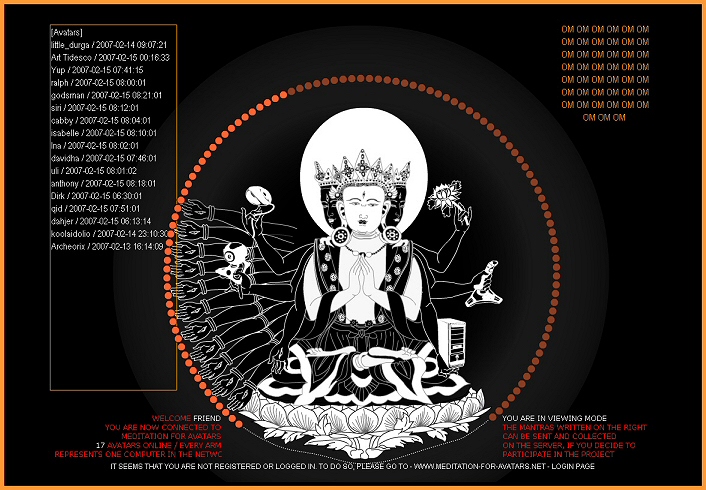
I’m not sure if I’m intrigued, amused or disturbed by this art-of-technology experiment…
Meditation For Avatars isn’t a computerized meditation aid. It’s actual computer meditation, by way of the disciplined repeating of Buddhist mantras. Not only doesn’t it meditate by itself, but networked with other computers that form a community, a concept at the heart of Buddhism.
Several thoughts spring to mind (at least my mind).
- Artificial Intelligence, Consciousness, Enlightenment: There is a theory (at least in Science-Fiction) that if enough computers are connected, consciousness will spontaneously arise. My favorite example is in Heinlein’s classic, “The Moon Is A Harsh Mistress”: Mycroft “Mike” Holmes is a self aware computer, who was born with a juvenile prankster’s sense of humor. Meditation For Avatars would appeal to Mike, I think. The cosmic humor in the concept of circuit boards reaching for enlightenment, is too much to resist. It boils down to illusionary consciousness meditating on illusionary enlightenment, a focus on improving the self, a self that doesn’t exist — not in AI terms, and not in Buddhist terms. As Mike would say… “Funny once, funny twice, funny always!”
- The Electric Monk: “… was a labour saving device, like a dishwasher or a video recorder. Dishwashers washed tedious dishes for you, thus saving you the bother of washing them yourself, video recorders watched tedious television for you, thus saving you the bother of looking at it yourself; Electric Monks believed things for you, thus saving you what was becoming an increasingly onerous task, that of believing all the things the world expected you to believe.” (This bit of surrealistic wisdom is from another favorite author, Douglas Adams. Yes, the same Adams who wrote the Hitchhikers series. The ‘lectric Monk appears in “Dirk Gently’s Holistic Detective Agency”). Meditation for Avatars IS the Electric Monk - except that it hasn’t decided the world is all the same shade of pink. Yet.
- Tibetian Prayer Wheels (or Mani) do set a traditional precedent for this sort of thing. Prayers or mantras are printed on rolls of thin paper, which are then wrapped around and around a central axis, and placed inside a protective wheel, which again has the mantra inscribed on it. The wheel is then spun, and each turn is a repetition of the prayer. More than just a prayer aid, the spinning wheel is considered effective in and of itself, without human intent or focus. Some Mani are set up so that they spin without human intervention at all, the spinning prayers powered by wind, water, or from heat from a flame. A computerized repetition of a mantra isn’t far from that.
- Potential For Actual Benefit? As humorous as the concept seems at the surface, this project could actually encouraging users to act with awareness, keep the mantras in their minds, and actually follow the examples of their computers in meditating, seeking higher consciousness, a connection with a mindful community, and other goodness.
I haven’t yet installed Meditation for Avatars, so I can’t tell you how it works — for now, I’ll just settle for soul-enriching laughter at this grand joke on the nature of illusion.