From the category archives:
Meditation
This Week’s Tweak: Be The Pebble (an anti-stress contemplation)
Long term readers are aware of the American Pseudo-Buddhist influence which underlies much of my thought process. (It’s good stuff, that Pseudo-Buddhism, especially when served over steamed rice and chased with saki -or so I’m told.)
You may also familiar with my unrelenting book addiction, fueled by frequent trips to the Half-Price book store, that dark-alley drug dealer that forces me to snort, smoke and mainline wholesale words and ideas indiscriminately.
So you’d probably expect me to have a pile of dusty books about Buddhism, Zen, and the like, right? Right. Last week, heeding the call of addiction, I dug through the stack and plucked out an unassuming white paperback from flipped through its pages and landed on a rather nice little meditation. Being the sharing sort (and feeling a bit lazy today) I thought I’d share it as this week’s mind tweak. Explanation of just why it’s a tweak follows, but first…
{ 3 comments }
Meditation: What’s The Point? Healthy Living or Spiritual Enlightenment?

Is meditation a self help method? Is it about healthy living? Medical Treatments? An antidepressant? Spiritual growth and enlightenment? All of the above? None of the above?
In the past few years, meditation has been promoted as a cure-all for personal and world troubles, with studies suggesting that meditation can lower blood-pressure, lift depression, reduce cholesterol, combat the effects of aging, and make physical changes to the brain, among other things.
These benefits have been so widely promoted that it’s starting to backlash - a recent review of the data concluded that were not enough solid clinical trials to prove the benefits enough for doctors to recommend meditation, which the media somehow twisted into ““Meditation Won’t Boost Health!” That, in turn has produced its own backlash, with researchers declaring the study itself flawed.
The whole thing had me ready to rant about everyone’s prejudices, sloppy science and journalism, when along came a post from GNF Brainblogger to put it back in perspective, pointing to the traditional intent behind meditative practices.
Here’s my take on it:
What most people (and most research studies) mean by “meditation” is a disciplined practice of concentrated attention, usually based on one of the traditional Buddhist practices.
Different forms of meditation focus attention through different means, but the tested and traditional practices all share the same eventual goal: spiritual enlightenment, and through enlightenment, the elimination of suffering.
“The Elimination of Suffering” sounds in tune with Western medicine, the self help movement, and ideas about healthy living, doesn’t it?
But here’s the rub… The traditional intent of meditation is not to eliminate suffering by lowering blood pressure or stress or even reducing physical pain, but to eliminate suffering by shifting perspective.
Meditation teaches you to turn attention *away* from the mundane physical and personal experience of world (where the problems seem significant), and learn to experience life through a broader, more interconnected perspective… “being one with everything” so to speak. The process transcends and changes our sense of self, so that our problems seem less  meaningful and less troubling. The point is not to reduce the physical causes of discomfort through improved health, but to change the importance we place on that discomfort — many long term meditative practices actually increase physical stress and discomfort.
So the very same meditations…
… that now get all the attention for their health benefits were designed to to de-emphasize the importance of an individuals health, stress levels, and personal issues. With this in mind, approaching meditation practices with a single-sighted goal of health-improvement is somewhat counter productive, and certainly counter-intuitive.
Additionally, traditional meditation is difficult, time-consuming and frustrating to master (especially without proper instruction and guidance). Though rarely mentioned by those promoting the practices, meditation can cause emotional issues to surface, raise fears and doubts, and even anxiety. On a spiritual path, these things are expected, even sought after… but if meditation is being used in its traditional forms to treat depression, anxiety, and stress — these difficulties become significant. It’s easy for beginning meditators to feel a profound sense of failure, which can deepen depression.
So Where Does This Leave Meditation Studies?
With a lot of research that suggests (but doesn’t prove) that meditation may  have a lot of physical and mental health benefits. The research also doesn’t yet tell us *why* meditation has those benefits, or what aspects of it create the positive changes. There’s a lot of promising research being done, but its still far too early for the media and self-improvement seminars to be pushing generalized meditation as a cure-all.
Personally speaking, I still respect, admire, and recommend a solid meditation practice for everyone. A long term practice will do more than tweak your mind — it’s closer to an extreme makeover that affects body, mind, and spirit.
But it’s not the effective quick-fix and cure-all that headlines often suggest, and it’s more difficult to achieve than generally believed.
People suffering from depression, anxiety, and major health issues may not have the focus and discipline to succeed at such a practice, much less the cope with the challenges fears and concerns that crop up along the way… and challenges do crop up, even in healthy, long term practitioners. Meditation is difficult -inspite of the claims of the new age gurus tell you otherwise.
A good teacher with a gentle, supportive and encouraging approach will go a long way towards minimizing the difficulties, and is almost a must if you want to use meditation as an aid for depression, anxiety or stress.
It’s worth considering other methods, too.
For health results and changes in energy and stress levels, it’s worth considering other techniques, methods that provide some of the same stress reduction, increased focus, lowered blood pressure, etc. Brainwave entrainment techniques, hypnosis, self hypnosis, and brain-training programs are easier to start and maintain than meditation, though admittedly they have less lofty goals than enlightenment.
I don’t want to leave the impression I’m discouraging meditation… I’m all for spiritual enlightenment, being in the now, and a disciplined mind — and I believe there are immense and many layered benefits to a meditation practice. But reducing traditional forms to a ”healthy living technique” does both the practice and its practioners a disservice.
So What’s The Point?
Meditation has a lot of benefits — some health related, some in the areas of personal development, some focused on spiritual growth.
But before investing time and energy into an in depth meditation practice, examine your goals and your resources. Are you looking for short term mental relief, general health improvement, or a life-altering spiritual practice, or all of the above? How disciplined are you? How much patience do you have with difficult new practices?
As much as I believe in meditation, as tempting as it is to suggest it as a catch all solution, other methods are worth considering as well… some of them may turn out to be just as effective, less difficult, and less stressful. _________________________
MindTweak:
Do not try to become anything.
Do not make yourself into anything.
Do not be a meditator.
Do not become enlightened.
When you sit, let it be.
What you walk, let it be.
Grasp at nothing.
Resist nothing.
If you haven’t wept deeply,
you haven’t begun to meditate.
.Ajhan Chah
_________________________
{ 0 comments }
Pzizz. The Sound Of Power Napping.
Pzizz is a nifty little bit of brain-hacking software, with one goal — improving your napping habits.
A calming voice, soothing hypnotic suggestions, ocean waves, chimes, music, and brainwave entrainment methods are combined to lead you into the other-worlds of sleep and back out again, all of it in the space of 20 minutes or so, the perfect power nap.
This is good stuff. Really. Very pleasant to listen to, relaxing, effective.
If you’re looking for advanced brainwave software, this isn’t it.
Pzizz isn’t exactly flexible. You can’t change the frequencies, the music, or even edit the suggestions. But Pzizz’s limitations are part of the charm. Just click a button (ok, two buttons) and listen.
There’s no figuring out whether I need alpha or delta waves, no worries about ramping, no decisions to make about which background file to listen to. Most of them are so complex that by the time I’ve figured out what I want to listen to, I’m stressed and nap-time is long since over.
That’s not to say Pzizz doesn’t have options: you can adjust the volume of the voice and music, as well as the length of the nap.
But it’s primary selling feature is in its automated variability; Pzizz never generates the exact same sound file twice.
If you’ve ever used a relaxation soundtrack repeatedly, you know how familiar it can become. Over time, it becomes predictable, boring, and even annoying; I learn to tune them out fairly quickly, and after a while, I find myself avoiding listening at all.
To avoid the “tuning out” issue, Pzizz uses an algorithm to vary the sound files it creates. No two “naps” are generated in exactly the same pattern. The suggestions, the music, the patterns of waves, the timing … all of it varies from file to file. At the same time, the tone and feel of the nap files remains the same, helping to create a sense of consistency and routine.
Currently there are two modules for the program… the original energizer nap, and a sleep induction module, which doesn’t wake you back up. The the developers promise that more modules are in the works.
You can listen to the files from within the software itself, export them to your MP3 player, or burn them to a CD.
Pzizz will set you back 29.99 for one module, 49.95 for both. It seems a bit on the pricey side (I’d like to see the add on module priced closer to $10) but not prohibitively expensive. Compared to the cost of similar individual entrainment/hypnosis sessions (which commonly run from $20-40 each) it’s quite reasonable, considering there really are infinite variations.
And its a perfect choice if you’re wanting to experience brainwave entrainment/hypnosis assisted relaxation, without the complex choices involved in the full blown entrainment software.
There’s a demo version of the software available (limited to 5 minute nap samples) and two full MP3 samples available for download. Or just hop on over and pick up the full version.
Check them out, and let me know what you think!
*Update 7-20-07: When this review was written, I had no affliliation with pzizz. But I finally decided that if I loved the product *this* much, I might as well be an affliliate. So, tada! You can now nap well, AND support your favorite tweaking blogger with your purchase of Pzizz!
{ 0 comments }
This Is Your Music … And This Is Your Music On Brainwaves.
Mind Stereo: A Software Review
Download the Demo
I’ve checked out a lot of mind-tweaking software over the years, and… well… to be honest, they’re usually over hyped, awkward to use, and don’t really do much, *if* they even run at all. Some seem to work, but turn out to be so technical that I lose interest before figuring out how to use them.
Mind Stereo from Transparentcorp is a pleasant exception. It does what it promises, and it does it simply and smoothly. MS takes your music, adds brainwave entrainment features to it, then and spits the tune back out at you through your monitor, headphones or speakers.
Brainwave entrainment may be a mind-numbing phrase, but it’s a pretty simple concept. The brain produces and processes a lot of electricity, in wave-like patterns — thus, “brainwaves” . The frequency of the waves varies according to the person’s activity and state of mind; calm, active, meditative, etc.
The nifty part is that it works in reverse… when exposed to wave-like rhythms, the brain will sync up and fall into step. It matches the new wave frequency, and creates the state associated with it.. ie, relaxed, energetic, and so on. That’s why certain types of dance music and dance-floor lights can put you in a sort of trance. Entrainment is a well proven and researched subject, so and I’ve used entrainment for relaxation, meditation, and treating those gawd awful headaches I’m prone to.
But getting back to the software… [click to continue...]
{ 1 comment }
Mind-Tweak Your Way To Heart Health
Meditation is one of my favorite mind-tweaks…. but it may tweak more than just your mind. Preliminary studies show that the benefits of meditation may include reducing the risks of heart failure.
In one test, a group of heart patients randomly were randomly assigned either Transcendental Meditation or general health education, as an addition to their standard treatment.
The TM group made measurable gains in tests of exercise capacity, quality of life and depression.
According to AllHeadlineNews another study in 2000 showed that practicing Transcendental Meditation may actually reduce the thickness of artery walls. Other research has demonstrated drops in blood pressure, and other stress related symptoms.
The DallasNews Religion blog makes some interesting points about the use of TM in these studies. Transcendental Meditation is the trademarked meditation of the Maharishi Mahesh Yogi, and is taught in his schools, for a fee. Apparently some of the researchers are associated with the schools, which would account for why it is the meditation form used in the studies. In general, TM is not much different from traditional forms of traditional Buddhist and Hindu meditations. Most of these would likely have the same effects, and free instruction is available in many places, including on the web. I’ll post links in the next few days, for those who don’t care to pony up the money to worship with the Maharishi.
Meanwhile, here’s the link to the current study, as reported in Scientific American.
{ 0 comments }
Taking a Mental Break: Brain-Flex v2
After writing the Smackdown post, my brain was a bit frazzled, so I took the opportunity to try out a brain wave entrainment mp3, Brain-Flex from Grasshopper Enterprises.
Many of these sorts of files seem to give me a headache, but this one did indeed seem to refresh, focus and energize me. It’s a bit long at 30 minutes, so I haven’t given it a full test whirl yet, but.. so far, it has my stamp of approval.
Check it out for free: Brain-Flex v2
{ 1 comment }
Tweakish Thoughts: “I am the eyes…”
I keep an eclectic collection of statements, mantras and ideas floating around in my head. It’s their job to periodically shake up my perceptions, remind me who I am, and keep things in perspective.
One of them jiffy-popped into my mind today, prompting this post.
“I am the eyes through which God sees.”
I’m not certain of it’s origins, but a quick Google suggests it springs from the Sufi traditions in Islam.
Try holding it in your thoughts for a day or two - the perspective shift works, whatever your understanding of “God” may be. Use it in a formal meditative or contemplative practice, or just casually think about it once in a while. I seem to remember carrying it rather far, once, as the ears with which God hears, the hands with which God types, etc. Keep your humility in place, please … I’m not responsible if you develop a budding messiah complex from this!
{ 0 comments }
A Peaceful Forest, Some Deer, and a Whole Lot of Playfulness.
 The Endless Forest is not intended as a mind-tweak; it just is one.
Designed as an interactive-screen saver, The Forest is a social game in which you play a deer, and interacting with other people playing deer. It sounds odd, and it is… but it is coolness beyond words, a reset button for the brain, and meditation, but ever so much more fun.
It’s damnably pretty, too. Check out the screen shots scattered through this post.
But it’s more than just the beauty of the system that makes The Endless Forest work as a MindTweak. The Forest is a game, but not in the sense of checkers, Monopoly, or Doom. Somehow, it takes you back to innocence, to childhood, to the simplicity of playing for the sheer joy of *playing* in the spirit of games you made up as children.
{ 0 comments }
Computerized Meditation
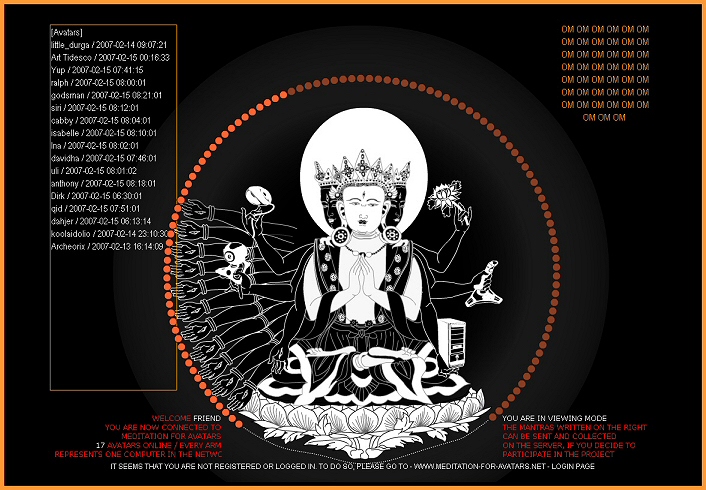
I’m not sure if I’m intrigued, amused or disturbed by this art-of-technology experiment…
Meditation For Avatars isn’t a computerized meditation aid. It’s actual computer meditation, by way of the disciplined repeating of Buddhist mantras. Not only doesn’t it meditate by itself, but networked with other computers that form a community, a concept at the heart of Buddhism.
Several thoughts spring to mind (at least my mind).
- Artificial Intelligence, Consciousness, Enlightenment: There is a theory (at least in Science-Fiction) that if enough computers are connected, consciousness will spontaneously arise. My favorite example is in Heinlein’s classic, [click to continue...]
{ 0 comments }