From the category archives:
Creativity
Volcano Virus!! (Creativity Gone Amok)
Writing for MindTweaks is an exercise in staying focused, on track, on topic and targeted. I know, I know… MindTweaks may not *seem* particularly focused, but in the great creative chaos that is my life, this blog stands out as a beacon of consistency and order. (scary, isn’t it?)
Still every once in a while, I need to indulge in a bit of writer-ly spring-break madness, let my hair down and spew out free-form insanity.
It may not be spring, but I need a bit of madness this week - and lucky you! I’m willing to share. So without further ado, I present my notes for the Next Big Hit!
It’s a novel.
It’s a movie.
It’s a hit album.
It’s an uber-moralizing-epic-eco-horror tale.
It’s…
Volcano Virus!!!!
{ 6 comments }
Learning To See: This Week’s Tweak
Tell people you’re an artist, and their first response is usually "I can’t draw so much as a straight line!" Well, you know… I can’t draw a straight line, either. I’ve got dreadful hand/eye coordination, and slightly shakey hands, so the pencil pretty much wavers all over the place.
Yet, I can do this:
Straight lines are important to engineering, but not art. So what is it that makes the difference between someone who can produce a passable sketch, and the "I can’t draw a straight line!" protestors?
Artists know how
to "see" the world around them.
{ 1 comment }
Emily … on The Brain
The Brain is wider than the Sky,
For, put them side by side,
The one the other will include
With ease, and you beside.The brain is deeper than the sea,
For, hold them, blue to blue,
The one the other will absorb,
As sponges, buckets do.The brain is just the weight of God,
For, lift them, pound for pound,
And they will differ, if they do,
As syllable from sound.
-Emily Dickinson
Complete Poems. 1924.
{ 3 comments }
And Now, For A Serious Change of Pace: The Squeak of the Mouse Tweak.
Remember this Week’s Tweak?
You only *thought* the exercise was silly.
… you hadn’t yet seen my results!
<Clears throat for dramatic reading>
AHEM.
There was a little mouse,
Who had a little house
He ate a lot of corn,
And watched a lot of porn.
But then he tired of rhyme
And quite forgot the time
Ran up the famous clock,
Hickory Dickory Dock
He still did not go blind!
(though the porn was on his mind)
The old wives tale was false
And he remained the boss.
‘Cause rolling mice gather no moss!
Cute Ears.
No Tears.
More Cheese,
Please.
(are we amused?)
{ 0 comments }
Monday’s… (oops… I mean Tuesday’s!) Tweak: The Mouse’s Tale
I’ve been so busy *not* writing about enlightenment, that I nearly forgot this week’s tweak. So I quickly whipped together a rather fun exercise, if I say so myself.
See the cute little mousie over there in the corner? Quiet little thing. Doesn’t have much to say, apparently. But everyone has a story to tell, so we’re going to help him tell his, by giving him words.
Ok, now… stop looking at me like I’m crazy. It’s just a simple word association game for gawd’s sake! 
Now that we’ve settled the question of my sanity, you’ll need to print a copy of our victim’s little mousie self. There’s a full size version here (or you can just click on the image, that’ll work too). [click to continue...]
{ 0 comments }
Open-Ended Creativity: Step Off The Map (and moo)
I’m often asked where I get my ideas, how I plan my words and images. People want to know how they can get THERE from HERE, dammit, and they’d like a clear cut, 10 step plan to milking their own creativity.
But I only have one step in my creative process: “Don’t Plan.” (Actually, it’s closer to “Make A Plan Then Willfully Ignore It,” but “Don’t Plan” has more punch.)
“Tipping Sacred Cows” is a good illustration of my process. It’s not a great post, but it made at least 3 people laugh hard enough to contact me privately — not a bad thing at all.
Here’s how it went:
A self-imposed deadline loomed on the horizon. I needed, desperately, to get a blog post written. It was a matter of life and death (Ok, well, maybe it wasn’t that serious) but I had a problem… the minute I opened Live Writer, one of my thistle-headaches burst into bloom. Wading through scientific research papers to tackle my planned posts was simply not an option.
Looking over my drafts, “Tipping Sacred Cows” caught my attention. I double clicked the title, opened the file, and saw.. nothing. It was just a title.
Admittedly, it was a clever title… maybe even an especially clever title. But there was nothing written, nothing started, not even a suggestion of where I’d intended it to go.
Out of sheer frustration, I started writing about what a clever title it was. After two sentences or so, an odd mooing started up inside my head (no, I don’t know how a cow got in there) and soon, I’d taken on the roles of both the Sacred Cow and it’s Tipper.
It amused me, so I wrote it.
Then I decided it wasn’t half bad.
After a few paragraphs, I realized not everyone would know what a sacred cow was, much less cow-tipping, so I jotted down the definitions. Once I’d taken that serious educational turn, it only took a few minutes to add a rather boring advice summary, which made it Mind-Tweakable.
I went back, deleted the paragraph about the cleverness of the title, slapped in a few cow photos, and.. Tada.
The resulting post was not even close to my original intentions for the title. It wasn’t related to my first stumbling paragraphs about clever words either. But in the end, it was humorous, insightful, and worthy enough.
The creative process worked, because I was open to wherever the post went. I took an open-ended approach, and followed the flow without a compass, chart, or map.
I just followed the mental-moo-muse.
_________________________
MindTWEAK: Put down the creative plans, article templates, and how-to books. Write, paint, dance, draw, or moo without purpose, without a goal. Rivers don’t follow maps. Maps follow rivers.
_________________________
(And yes, I promise to stop with the moo-metaphors… maybe.)
{ 4 comments }
Inspiration Doldrums? Beating the Dead Calm Effect
You’ve all experienced it; your normally churning sea of inspiration is now an ominous dead calm, and your mind bobs aimlessly on the surface of your task list.
The waves dont wave, and the winds don’t wind. The pressure rises, forcing you to slog against its oppressive, humid weight.
A near panicked voice cries out from below. “Blog, dammit, BLOG!” as if its very life (and yours) depends upon your ability to put words into pixels… or whatever form of creative torture you subscribe to.
I’m having one of those afternoons.
It’s been 2 days since my last post, putting me over my self imposed limit on blog silence. The stack of drafts and topics and nudge-notes in the sidebar of Live Writer glowers at me threateningly, but nothing, NOTHING is inspiring me.
If I’m not inspired, my writing isn’t inspired.
If my writing isn’t inspired, it’s dull… and drumish, too, I guess, in the sense of repetitive beatings more in line with a first year band student than an inspired rock solo.
I refuse to dilute a potentially brilliant post with a drumming dullness. So what is a poor blogger to do?
Pick up the oars and row.
Force yourself into action/motion. Stop waiting for inspiration and meaningfulness to strike with hurricane force , and become your own headwind.
Don’t think too hard on what to do… The direction isn’t nearly as important as motion itself. Free write. Use creative nudges. Try the 10+2 Procrastination Hack.
Or my own personal favorite?
Do Something Else.
And that is precisely what I’m going to do. Stand up, step away from the keyboard, pick up my oars, and go ElseWhere. I’m not even going to stop to add links or a pretty picture of a boat to this post. I’m just going to chart a new course, and head for the horizon.
In this case, ElseWhere is probably the local Walmart.
While I’m braving the horrors of the Big Blue Box, have you got your own methods of breaking the Dead Calm Effect? I’d appreciate hearing them!
{ 5 comments }
Murder Your Darlings: Dangerous Creativity Meets Rosemary’s Baby
I’ve forgotten where I first ran across the brilliant, dangerous advice to “Murder Your Darlings, “ but I’m in good company, it seems. A quick web-search shows that it’s been attributed to Faulkner, Fitzgerald, Twain, Wilde, and about a quadzillion other word-smith serial-killers.
The most likely source is Sir Arthur Quiller-Couch, who, in 1914 or so, quipped:
“Whenever you feel an impulse to perpetrate
a piece of exceptionally fine writing, obey it
— whole-heartedly — and delete it before sending
your manuscript to press. Murder your darlings.”
Your “darlings” are those brilliant strokes of your writer-ly wit. They’re the most astoundingly beautiful interplay of paint that ever appeared on your canvas, the best and brightest ideas that you as a Creative have ever had. Darlings are our indigo-children, the fruit of our labors, the idiot-savants we nurture and coddle and pet-pet-pet, the ones we keep under our pillow so we can admire their shine, even in the dark of night.
It’s an exhilarating moment, when we fall in love with our own creations.
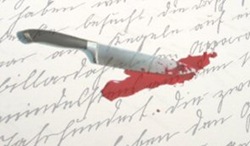 But it’s equally exhilarating to take the knife to their throats, spilling their blood onto the page and canvas - in love, worship and adoration.
It takes some getting used to, at first, all this blood-letting of beloveds - It takes time, practice, and a lot of rationalization to be comfortable with it.
If you’re the possessive type, try thinking of it as keeping your precious babies all to yourself, refusing to allow anyone else to share in their love.
If you’re the nurturing type, considered it a kindness, protecting them from the prying, critical eyes of the outside world.
Being the dramatic spiritualist that I am, I approach it as a dramatic sacrifice, spilling the blood of my precious for the good of all.
Why do I kill my darlings?
And more to the point, why should you?
Because they get in the way.
Left to their own devices, darlings will suck away your creative flow. Who hasn’t wasted hours admiring that perfect phrase, that brilliant blot of paint, while struggling to match it to *anything* else of importance?
Darlings grow into creative blocks, a Hoover dam of perfectionism that refuses to budge. They force you to go around them, to build a framework to support them, a framework that will never do them justice.
They’ll keep you from editing properly; you’ll catch yourself trimming and polishing in order to show off your darlings rather than to advance the story or article. You’ll never notice if the darlings themselves are in the way of the story (which they usually are).
Most importantly, ”darlings” draw attention to the writing, and steal it from whatever point you’re trying to get across. It’s tough for me to say this, but… the last thing a writer really needs to hear is “you write well”.
REALLY good writing is invisible. Creative darlings are a vanity, divas hogging the spotlight, staying center stage long after their scene is over, feeding our egos off and starving our meaningful work.
Beautiful though they may be, they are demanding, needy, spoiled brats.
So you, me, and every other creative type out there has a tough choice to make.
Do we want to write perfect phrases that will be praised, or do we want to write a full article, a story, a play? Do we want to paint a spot of beautiful color, or an entire scene that works together?
If we want to be good creative parents to our projects (and not just parent PARTS of our projects) we’ve got to be strict disciplinarians, despots, and tyrants…
Because those darlings have got to go. Rationalize it however you must, but sacrifice them, spill their blood.
Don’t limit your rampage to writing. Kill off any and all pet creative projects you’re overly attached to. Toss out that cheap end table you’ve refinished 5 times in 30 years, that never goes with anything. Cut up that silk skirt you bought 3 years ago and have never worn. Take a razor blade to your life.
Be murderous, be dangerous.
Be brave.
Create.
MindTWEAK: Please, please don’t admire all my shiny pretty metaphors. I’m only publishing this as an example of what not to do, you know. Pay no attention to that small darling behind the curtain.
{ 2 comments }
What Does Your Bookshelf Say About You?
 That’s the question that Roger von Oech of Creative Think was asking this week.
For those who aren’t familiar with Roger, he’s the creator of the Creative Whack Pack, the Ball of Whacks (a tool for innovation) and a lot of other cool stuff I’ve meant to review for some time now.
As you might imagine, he’s prone to asking creative questions.
Questions like, for instance, “What does your bookshelf say about your worldview?”
I thought it was an interesting question, so I decided to sit down and ask my bookshelf about it.
Almost immediately, I found a problem.
WHICH bookshelf should I ask? There are the two closest to me, in my studio. There’s one under my bed, 2 small ones and one huge one in my old office/current store room. Another large one in the spare bedroom/astronomy/weight room, the empty one in the living room, or those boxes and boxes stashed under the spare bed make a total of .. well..
…I lost count.
However many there are, they must all be very opinionated, because each and every one of them seems to

have something to say.
All at the same time.
To be honest, they are giving me a headache.
I’m sure you’d be amused by their individual commentaries, but I’m a bit pressed for time, so I’ll settle for relaying the gestalt of their views.
To start off with, they say my worldview is many layered and fractured, and far too complicated to sort out in one blog post. They’ll settle for telling you a bit more about me, personally, in a somewhat disparaging tone.
They want you to know things like how I really should have completed the refinishing job before stacking books back into the antique library case. That I keep promising to get rid of the riff-raff titles, but never do, and that the book on Biblical scholarship REALLY should not be sandwiched between to “Flesh of the Gods” (hush, its an anthropological study) and “1000 Nudes” (ok, that one is exactly what it sounds like.)
Further, they are of the strong opinion that cardboard boxes are NOT suitable as bookshelf brethren, but they rather liked the dresser-drawers I used to use as shelving, mounted on the wall.
They say that I am a packrat. That I believe if I own a book on a subject, I own the knowledge, and one should never turn from knowledge. I value the old, and am in lust with the new. I’m spiritual, I’m technical, I’m fascinated with creativity and imagery and symbolism and cultures. They say that I like things to *look* pretty and neat, but that eventually the stacks of knowledge overwhelm me, and things wind up “wherever”. I like the surreal, whimsy, and a pretense of order.
And so they clamor, and fuss, and look down their stacks at me.
All but one.
The empty shelf over the fireplace is the littlest voice, but the most telling.
It has not yet served as a bookshelf. Cleared off at Christmas to make room for the obligatory nativity set and victorian villages, the regular knick-knacks never got put back in place.
So the shelf waits. Quietly, patiently, smiling, a still quiet voice.
I’ve been thinking that meaningful, attractive, library-bound books would be good there. Books that would impress, enlighten and reveal. A readers-digest condensed version of who I am. Foundational books. Life changing books. The books that find their way into my daily metaphors for life. The books that tell my life stories, even as I tell theirs, over and over again. Classic, eclectic, intellectual whimsy.
The bookshelves like that idea.
I can hear them nattering at other, debating which of their treasures they would give up for the cause, and which ones would need to be replaced with better volumes.

There seems to be only one title they all agree on: Alice’s Adventures in Wonderland (one with Arthur Rackham illustrations, of course. Collectible leather bound preferred).
Apparently, they feel that if I’m going to go about having profound conversations with my bookcases, it might as well be in a world where such things are not altogether remarkable, and one with pretty pictures.
So here’s my question to you:
What does your bookshelf say about you? About life? About anything? (Oh now, stop groaning. You had to KNOW this was coming.)
And along with what your bookshelf says, I’d like to know *how* it says.
Does it speak with a Scottish accent? Does it use $10 words or colloquialisms talk like a hick? Does it offer you a cup of tea or sniff disdainfully and point out the feather duster?
Leave a comment, write a post, take a picture, do a podcast. I don’t care.
But please give your bookshelf a voice, for it’s own amusement. (and mine).
MindTWEAK: “Oh, you can’t help that,” said the Cat:
“We’re all mad here. I’m mad. You’re mad.”
“How do you know I’m mad?” said Alice.
“You must be,” said the Cat,
“or you wouldn’t have come here.”
(And if you still haven’t checked out Roger von Oech’s blog?
Check out how *HIS* bookshelf talked back. In full color, yet. Now THAT’s creative.)
{ 8 comments }
Dangerous Creativity: Five Points To Remember
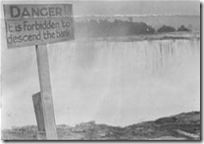 Look for the darkspots: Seek out the shadowed corners of your life, your psyche, your worldview. Poke around in the crawl spaces. What hasn’t been exposed to light? What hasn’t been revealed? What are you or others afraid to look at? Shadows do hide horrors at times, but they also hide forgotten treasures, history, hope and beauty.
Don’t dismiss the difficult: If an idea seems too dangerous or too difficult to approach, don’t automatically turn away. Stop and consider it a while. What makes it difficult? Why do you want to avoid it? Are the reasons valid? Are there ways around the dangers?
Don’t gut it: It’s tempting to slice and dice dangerous ideas, and you can indeed water one down so it is safer, more commercial, more acceptable. Of course it will also be empty, meaningless, and bland. Better to *start* with a safe idea, than to drain the life power out of a dangerous one.
Stay Risk Aware: Once you’ve identified the risks, and decided to go forward anyway, stay aware and alert. Forgetting the dangers means you can be blindsided by them, and stopped dead in your creative tracks. Staying aware also keeps you energized, attentive, focused - and reduces the temptation to water things down. As the project becomes more familiar, it will start to feel more safe.
It isn’t safe. that’s the point! Don’t forget it.
Related:
{ 0 comments }