Posts tagged as:
The Basics
What Is Neuroplasticity?
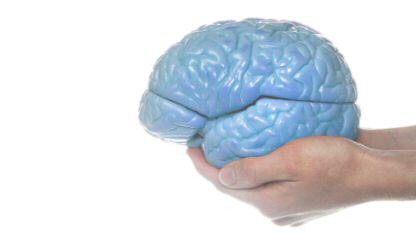
Neuroplasticity is my favorite new buzzword; not so much because of its meaning (which is pretty impressive) but because of the image it invokes: my brain, modeled out of cheap plastic, and distributed via Mattel.
In fact, the Mattel/China toxic paint debacle might explain a lot…. perhaps my neurons have been recalled? I’ll have to check it out. Meanwhile, on with the defining!
Neuroplasticity is the brain’s ability to reorganize itself, generate new cells, new neural pathways, and to change which areas control which functions. It’s become a buzzword for good reason; new understandings of neuroplasticity are turning assumptions about our minds and brains upside down.
One of the basic beliefs about the brain was that once it matured, it was fixed. Neuroplasticity was a function of a developing breain, or so it was assumed. The ability to learn new tasks was believed to be strictly limited, and many of the brains functions (including intelligence, levels of happiness/emotional stability, and mental health were thought largely fixed. Mental decline was considered inevitable with aging, and adult victims of stroke, brain injury and disease were without much hope of improvement.
But modern neuroscience shows that the adult brain remains remarkably flexible. It can reorganize itself after extreme injury and trauma. It can grow. It can form new connections, change wiring, eliminate old wiring.
Perhaps most astounding are discoveries that it adapts not only to external experiences, or to correct injury, but can adapt and change according to our internal thoughts. How we *think*, what we think about, the activities we engage in, the things we value and focus on and practice — they change the physical structure and neural pathways in the brain.
I’m trying to avoid the heavy science here, because I want to get this one point cemented.
Our brains.. my brain, and *your* brain…. are capable of astounding change and growth, for good or ill.
Some of that change is within our ability to control.
It’s worth learning about.
It’s worth learning about, because that process of learning itself changes our brain.
And *that* is neuroplasticity, applied 
_______________________________
MindTWEAK: Turns out, you CAN teach an old dog new tricks!
_______________________________
{ 2 comments }
How To Judge An Expert: Soft or Hard-Boiled ?
Expert opinions are traditionally priced at dime a dozen, but an internet-induced expert explosion has caused wolrd-wide rates to plummet. Rumor has it that an entire internet expert (and not just his opinions) can now be bought for the price of a beer and a bagel.
(Personally speaking, I’d ignore an expert who drank beer with his bagels, but I am a Texas girl, and I don’t have much experience with bagels.
Texas girls do, however, receive considerable education on the topic of beer. In fact, we might be called experts on the subject, if you weren’t too particular about the meaning of the word “expert”, which brings us neatly out of this aside and back to our topic. Ahem.)
Neuroscience is booming, and the market is responding with a wealth of brain-training devices, games and methods, all endorsed by various experts.
But what makes an expert’s opinion expert? Do credentials matter, or does experience? How do you decide which expert to listen to? (After all, experts are notoriously contrary, and two rarely agree on a single opinion, especially where beer is involved. )
Scientific American Mind’s Yvonne Raley offers some good guidance in the June/July issue. Since I’m feeling a bit lazy today, I thought I’d borrow her bullet points, rather than starting from scratch.
Qualifying Hard-Core Experts _________________________
So What makes any old expert an expert worth listening to?
1. Relevant Expertise
“An expert is one who knows more and more about less and less.” - Nicholas Butler
Humorous on the surface, Butler’s comment is funny because it is true. An expert isn’t someone with great and broad life experience or even a lot of smarts — an expert has specific knowledge and experience in a narrow field.
No matter how smart a quantum physicist may be, he is not an expert in neuroscience. A well educated and respected theologian is not an expert in evolutionary biology. A celebrity bagel chef is not an expert in nutrition for aging elders.
Seems like a no-brainer, doesn’t it? But irrelevant appeals to authority are probably the most common misplaced claim to expert status.
2. Neutral/Impartial Approach
People (even really smart and otherwise ethical people) are not good at separating their opinions from their vested interests; we’re naturally biased creatures, and this affects our judgement. It doesn’t nullify an experts opinions, but it means they need to be looked at with more skepticism. For instance, an expert in hypnosis develops and markets their own hypnosis software system, their opinions on the effectiveness of hypnosis (and their particular methods) are no longer impartial. Investments can be financial or emotional, and again… they don’t invalidate expert opinion, but they do make them less reliable.
3. Bona Fides
A reliable expert will be officially and verifiably recognized in their field of knowledge; the claims have to stand up to a background check.
- Experts should have a degree *in their specialty* from an accredited university. The more established and respected the school, the better, and if the university is known for a top flight program in that field, even better.
- A qualified expert will usually have affiliations with *impartial* and recognized institutions and associations in their field - universities, research institutes, professional associations, etc…. with the emphasis on *impartial*. Many self-proclaimed experts fake or exagerate affiliations, others go so far as to start their own institutes and affiliations. The institute lends them credibility, they lend the institute credibility, and .. tada. Instant (questionable) expert.
- Publication is another standard for assessing an expert’s credentials, but all published articles and lectures are not not created equal; peer-reviewed articles in scientific or professional journals are the most reliable indicators. The rules of quality, relevance and impartiality still apply. Having a website, blog, or even a book by a mainstream publisher and appearances increases public visibility, but doesn’t assure that the individual is knowledgable in their claimed area of expertise.
Life-Qualified “Soft” Experts
_________________________
But what about people who don’t meet those standards? Can’t they be experts in their own way? Do we have to value credentials over wisdom and life experience?
In the SciAm Mind article, Raley addresses these often sticky issues by designating experts as “hard” or “soft”.
A hard expert is someone who can clearly be evaluated by the criteria above: relevant education, respect from others in their feild, and so on.
A soft expert is someone with related knowledge or experience, but who may not be qualified to give professional advice on the subject. For instance, a minister, hospice nurse, or counselor might offer advice in a medical situation which involved moral choices or psychological stress; a decisions about a family member in a vegetative state, an unexpected pregnancy, an organ transplant, for example. The medical advice itself is outside of their qualified area of expertise, but they may still have good information they can add to the equation.
Judging a soft-expert isn’t all that different from judging a hard-expert. The same basic criteria apply, with a few changes.
1. Relevant *Experience*
With a soft expert, the relevancy of their experience is more likely to matter than their education or work-field. How similar is their experience to the situation we’re facing? Do they share our assumptions about moral, ethical, and religious views? How much similiar experience do they have, and how many others in related situations have they had contact with?
2. Open-Minded Approach
True neutrality is less likely in a soft expert, but it’s still important that they be somewhat open-minded. Is the person capable of setting aside their own often strong feelings, to support whatever conclusions you may come to? Do they have a powerful emotional investment in their own view that may override conflicting ideas or needs? Are they financially invested in the outcome of your decision? Are they part of a related political movement, more interested in converting you to their cause, than offering unbiased advice?
3. Check Their Story
Checking bona fides on a soft-expert is a bit tricky; they may quickly admit to not have any credentials or references. But if they’re published, is it by a reputable publishing house with high standards, or a a print-on-demand work, or something in between? Self-publishing no longer carries the stigma it once did, but it requires no peer review or fact checking, and there’s no well-heeled publisher to sue if the info turns out to be wrong or dangerous. The same goes of websites and blogs — are they part of a network of sites that holds its members to standards? If it’s a blog, or email list, do they allow and answer critical comments?
You can usually check on their affiliations and reputation fairly easily. Do they belong to organizations in their area of interest? Do others respect and follow their advice, on and offline?
At the least, make sure the person offering advice is who they say they are, and that they actually have the experiences they claim. Some unscrupulous people invent or borrow stories to back up their positions, gain sympathy and credibility. Imagine struggling with the decision of a family member in a persistent vegetative state mentioned earlier, turning to an online support group, being influenced by the opinions of its members, only to later discover several members had invented their experiences. Check up on stories and identities as much as possible.
The advice from a soft-expert should not outweigh the opinions of a qualified hard-expert, nor should it outweigh your own opinions, but since soft advice may *influence* your eventual decision, the source of even the most casually presented authoritative opinion needs to be assessed.
So, To Review:
_________________________
Expert opinions should be reviewed for:
- Relevancy
- Neutrality
- Education/Degree
- Relevant Associations
- Peer-Reviewed Publications/Peer-Offered Respect
Not meeting these standards doesn’t invalidate an opinion, but it does make it less “expert”, and therefor worth a bit less than the aforementioned beer and bagel.
And while you may be tired of hearing about said beer and bagel, I should still be congratulated on my restraint. Afterall, I made it through the entire soft vs hard-boiled metaphor without lowering myself to the over-easy eggspert puns.
__________________________
MindTWEAK: The modern world bombards us daily with a wealth of information on countless subjects; as a result, we know less and less about more and more. Countering the information overload means consulting more experts. Learning to judge those experts, how to value or devalue their opinions, is crucial.
It’s either that… or you can start tossing coins at every opportunity, an idea which, admittedly, has its charms.
__________________________
{ 1 comment }
What Is A Mind-Tweak, Anyway?
I’ve been waiting for you to ask that! You haven’t, of course. I’m sure you’re just being shy, so I’m going to answer you, anyway.
Optimize Your Mind
A mind-tweak is a small adjustment to your mental-works. It’s an intentional change that fine-tunes and optimizes your mind. It’s like a hack, but less violent (and a wee bit less geeky).
Tweaks come in a variety of flavors, from the purely mental (new ways to think about things) to the purely physical (better brain-care). They can be spiritual (meditation), psychological (cognitive shifting), technological (brainwave entrainment) or.. well… Let’s just say there’s more variety in mental tweakage than Heinz ever considered.
The Science of Tweaks
Mind-tweaks are an exciting topic to cover these days, with the neuroscience boom. Researchers have discovered that the brain is far more adaptive than once believed; areas of it continue to grow, change, and develop throughout life, not just in childhood as previously believed.
Just as exciting is the developing knowledge about the mind/brain connections. For decades, it was assumed that while the brain helps shape thoughts and consciousness, it wasn’t a two way street. Those assumptions have been turned on their head in the past few years, as studies show that the way we think, and what we do, and even the very act of thinking itself, can change not only the chemistry of the brain, but its actual physical structure.
New Toys
These discoveries are giving rise to a whole new segment of software, games, and other products designed to help you think yourself a better brain, and the market is ready for them.
As the Boomer population in the US ages, the demand for ways to keep the brain sharp in later years is higher than ever.
Simultaneously, younger and middle generations are facing new demands in a changing workforce; they’re looking for new and creative ways to structure both work and personal lives,creating a boom in productivity and organizational products.
It all adds up to a lot of really cool research, toys, and methods to talk about and experiment with.
I’m having fun being the guinea pig for some of these methods, and even more fun developing my own along the way. It’s my hope that as the blog grows, other guinea pigs will join me, sharing their ideas and experiments as well as any new mind-tweak related products you come across, but if you don’t, that’s ok too. You’ll just have to read that much more of me rambling about it instead : )
MindTweak: I’m doing a new thing here. Simple, back to basics, building block posts, posts that address simple questions, posts to remind me (and you) not to get lost in the fancy stuff and neglect the basics.
{ 4 comments }